

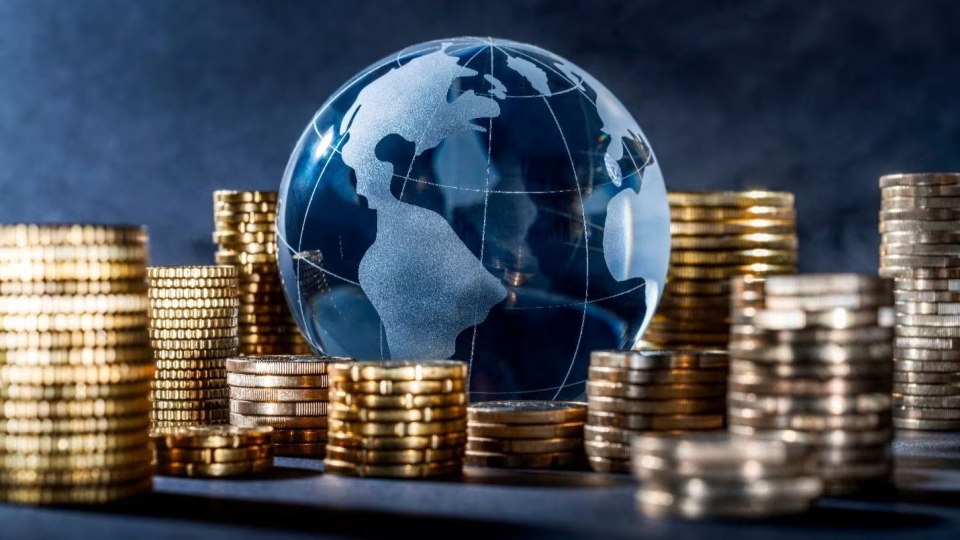
The global economy in 2026 stands at a fascinating intersection of technological innovation, shifting demographic trends, and evolving geopolitical realities. After years of post-pandemic adjustment and aggressive monetary policy responses, the international financial system is entering a period characterized by cautious stabilization and structural transformation. For businesses and individual investors alike, understanding the nuances of the current economic climate is essential for long-term planning and risk management. We are witnessing a transition where traditional growth drivers are being supplemented, and in some cases replaced, by digital efficiency and sustainable industrial practices.
The Pillars of Current Economic Resilience
Modern economic stability is no longer solely dictated by manufacturing output or raw commodity prices. Instead, it is increasingly defined by the agility of service sectors, the strength of labor markets, and the speed at which capital can be reallocated to high-growth industries. In 2026, several key factors are propping up global economies, providing a buffer against localized downturns and supply chain disruptions.
-
Digital Infrastructure Investment: Nations and corporations are pouring capital into AI-enabled productivity tools and resilient logistical networks. This investment is lowering the cost of doing business and enabling smaller entities to compete on a global scale.
-
Labor Market Adaptability: Despite the integration of advanced automation, the demand for human expertise in complex problem-solving remains high. Flexible work models have allowed for a more efficient distribution of talent, keeping participation rates stable across most developed markets.
-
Monetary Policy Normalization: Central banks have largely moved past the emergency interest rate environments of the early 2020s. The current focus is on maintaining price stability while fostering a predictable environment for long-term investment.
-
Energy Transition Efficiency: The shift toward sustainable energy sources is no longer just an environmental goal; it is a major economic engine. The creation of new energy grids and storage technologies is fostering job growth and reducing long-term energy price volatility.
The Role of Technological Innovation in Economic Output
The most significant driver of economic performance in 2026 is the maturity of the digital economy. We have moved past the hype cycle of earlier technologies and are now seeing meaningful, bottom-line impact. Automation is now a standard practice for managing inventory, optimizing financial flows, and streamlining customer interactions. This has led to a significant increase in total factor productivity, which is the most sustainable way to drive long-term economic growth.
When businesses operate with higher efficiency, the downstream effects are felt across the entire economy. Reduced overhead costs allow for more competitive pricing, which keeps inflation in check and boosts consumer purchasing power. Furthermore, the ability to collect and analyze massive datasets in real time allows for better government policy and more accurate private sector forecasting, reducing the likelihood of large-scale market bubbles or systemic failures.
Geopolitical Shifts and Trade Dynamics
Global trade is undergoing a fundamental reconfiguration. The era of blind globalization is being replaced by a more nuanced model of regionalization and strategic partnerships. Nations are prioritizing the security of their supply chains, particularly regarding critical minerals, high-end semiconductors, and pharmaceutical components. This shift is creating new economic hubs in regions that were previously peripheral to global supply chains.
This transformation requires companies to be more deliberate about their geographical presence. The strategy of outsourcing for the lowest possible labor cost is being supplanted by a strategy of reliability and proximity. While this may increase short-term production costs in some instances, it provides a crucial insurance policy against global instability. We are also seeing a rise in specialized trade agreements that focus on digital services and intellectual property, reflecting the shift toward a knowledge-based economy.
Understanding Inflation and Interest Rate Environments
Inflation remains a central focus for economic management, yet the landscape has changed. In 2026, inflation is increasingly influenced by structural factors, such as aging demographics and the cost of the green transition, rather than just transient demand spikes. Central banks have become adept at managing expectations, using communication as a primary tool alongside interest rates.
For businesses, this environment requires a disciplined approach to capital management. The days of cheap, abundant credit have passed, forcing companies to focus on organic cash flow and efficient capital allocation. While higher borrowing costs act as a drag on speculative investment, they also force a higher quality of business activity. Companies that are successful in this climate are those that have strong margins and clear value propositions, rather than those relying on continuous capital injection.
Human Capital and the Future of Work
The economic contribution of the workforce is evolving rapidly. As routine tasks continue to shift toward automation, the economic value is concentrated in roles requiring high cognitive function, creativity, and emotional intelligence. This shift has significant implications for education and vocational training. Economies that are investing in lifelong learning programs and upskilling their populations are seeing higher levels of resilience.
Furthermore, the rise of the platform economy has allowed for a more fluid interaction between skilled workers and the organizations that need them. This flexibility is a net positive for the economy, as it allows for the rapid deployment of talent to solve critical problems. It also puts pressure on traditional business models to offer more than just a paycheck, forcing a rethink of how employee value is measured and rewarded.
Sustaining Growth through Sustainability
Sustainability has become inextricably linked to economic health. The transition to a circular economy, where resources are reused and waste is minimized, is creating massive opportunities for innovation. This is not merely a regulatory burden; it is a way to reduce reliance on volatile commodity markets and create more robust, local supply chains. Countries that lead in green technology are securing a competitive advantage that will define the global economic hierarchy for the coming decades.
The investment community has also adjusted, with a heavier focus on long-term value creation rather than quarterly gains. This shift in sentiment is encouraging companies to invest in the long-term health of their assets and the communities in which they operate. The convergence of financial performance and social responsibility is a powerful trend that is stabilizing the broader economic environment.
Frequently Asked Questions
How does the current focus on AI impact individual household wealth?
AI-driven productivity gains can lead to lower prices for goods and services as production costs fall. While it changes the landscape for certain professions, it generally raises the overall standard of living by allowing individuals to accomplish more with less time and effort. Over time, this efficiency supports broader economic growth.
Are we seeing a permanent end to globalization?
No, globalization is not ending, but it is changing. It is becoming more focused on resilient networks rather than efficiency at any cost. We are shifting toward a system of deeper regional integration combined with highly targeted global trade in sectors like technology and research.
What is the best way for a small business to protect against economic volatility?
Focus on diversification—both in terms of your customer base and your supplier network. Maintaining a healthy cash reserve and minimizing high-interest debt are also critical. In times of uncertainty, businesses with strong cash flow and low leverage are the ones that maintain stability.
Why are interest rates higher than they were a few years ago?
Rates are higher because the economy has shifted from a period of extreme, emergency-based stimulus to a more normalized environment. Higher rates are a reflection of a functioning economy where capital has a real cost, which discourages wasteful spending and promotes smarter investment.
How do aging populations affect global economic growth?
Aging populations present a challenge to growth as the labor force shrinks. However, this is being offset by investments in automation and AI, which allow a smaller workforce to maintain high levels of productivity. Furthermore, it is pushing economies to value experience and knowledge-based output more than physical labor.
Is the current economic model sustainable for the long term?
The current model is significantly more sustainable than in the past because it is integrating efficiency, digital technology, and environmental considerations. While challenges remain, the trend toward smarter, more data-driven resource management is providing a solid foundation for future stability.
What is the role of government in shaping the economy in 2026?
Governments are shifting their role from direct intervention to providing the framework for private sector growth. This includes investing in foundational technology, ensuring the stability of financial markets, and creating policies that encourage innovation and workforce development.
