

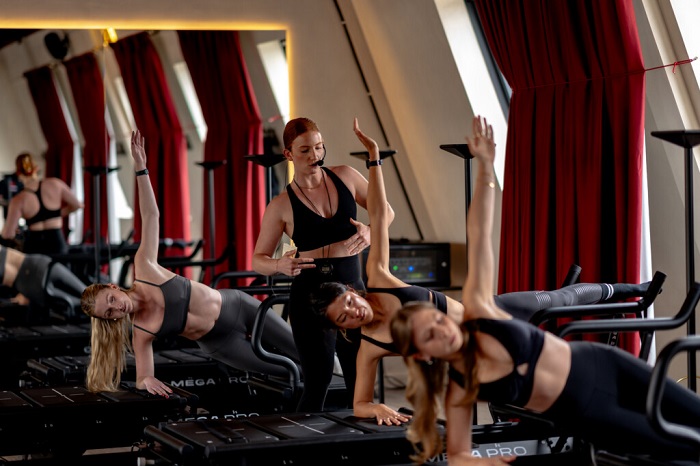
A Reformer class is limited by more than the number of machines that fit inside the room. Every participant works with a moving carriage, springs, straps and an adjustable footbar. When booking reformer pilates Singapore, members should consider whether the class size allows the instructor to monitor equipment setup and movement quality effectively.
A full room can still be well organised, but capacity must reflect the complexity of the format, participant experience and instructor access.
Each Reformer Is an Individual Workstation
Unlike a mat, a Reformer has several adjustable components. Spring configuration, footbar position, straps and carriage setup may change throughout the class.
A setup error can alter the exercise substantially. The instructor needs time to confirm that participants understand each transition before movement begins.
As class size increases, the number of equipment changes also increases. If ten participants make three adjustments during a sequence, the instructor is effectively monitoring thirty setup events.
This workload affects how quickly the class can move without becoming rushed.
Cueing Needs to Be Seen and Heard
Verbal cues are useful when participants already understand the equipment. Newer members may need visual demonstrations and individual clarification.
The instructor also needs to see whether the cue produced the intended change. Repeating instructions without observing the response is not effective coaching.
Room layout influences visibility. Reformers arranged tightly or behind columns may conceal hand placement, spring setup or carriage movement.
A suitable capacity allows the instructor to scan the room and approach each machine when needed.
Class Experience Changes Supervision Demand
A group of experienced members may move through familiar equipment changes efficiently. A class containing several first-time participants requires more explanation.
Studios can manage this through introductory sessions, prerequisite policies or limits on the number of newcomers in selected formats.
This does not make Reformer training exclusive. It recognises that equipment familiarity affects the instructor’s workload.
A class description should explain the expected experience level clearly. Members should not need to guess whether they are prepared.
Larger Classes Can Encourage Generic Cueing
When an instructor has many participants to monitor, cues may become broad and repetitive. Individual differences in body proportions, mobility and exercise history may receive less attention.
Generic instructions are not always poor. They allow the whole class to move together. The problem arises when the instructor cannot notice that a cue is unsuitable for a specific member.
Smaller class sizes generally create more opportunities for personalised range, spring and tempo adjustments.
Members should still understand that a group class is not a private session.
Capacity Affects Transition Speed
Equipment transitions consume time. A class with more participants may need longer to change springs or straps safely.
If the timetable remains fixed, the instructor may respond by rushing instructions or reducing observation. Neither produces an ideal experience.
A realistic class plan includes:
- Demonstration.
- Equipment adjustment.
- Participant confirmation.
- Exercise time.
- Individual correction.
- Rest where needed.
- Controlled transition to the next setup.
The exercise list should fit the available time rather than treating setup as wasted minutes.
Instructor Access Is a Safety Requirement
The instructor may need to approach a machine to clarify spring selection or help a participant stop safely. Narrow walkways and personal belongings can obstruct access.
Reformer spacing should provide clear routes around the room. Bags and bottles need designated storage.
The instructor should not need to climb over equipment or pass through another participant’s movement area.
Capacity therefore depends on usable teaching space, not only machine count.
Business Economics Still Matter
Reformers, premises, instructors and maintenance create substantial operating costs. Studios need enough attendance to sustain the timetable.
Increasing class size may improve revenue per session, but only until quality and retention begin to decline. A crowded class with poor instruction can create higher customer turnover and instructor burnout.
Studios should review:
- Repeat booking rates.
- Member retention.
- Waitlist conversion.
- Instructor feedback.
- Equipment incidents.
- Late arrivals.
- Class-level complaints.
- Revenue per available Reformer.
- Newcomer conversion after introductory sessions.
These measures provide more context than occupancy alone.
Members Can Evaluate the Experience
Clients do not need technical expertise to assess whether class size supports coaching.
Useful signs include:
- Equipment instructions are clear.
- The instructor can see each participant.
- Spring changes are confirmed where necessary.
- Members have enough time to transition.
- Individual alternatives are available.
- Walkways remain clear.
- Corrections relate to the actual movement.
- The session does not feel rushed.
Constant hands-on correction is not required. The issue is whether the instructor notices what is happening and can respond.
Progress Requires Consistent Feedback
Members improve when they understand which variables are changing. More springs, greater range and harder variations should not be added randomly.
In a well-managed class, the instructor can explain whether progress involves carriage control, tempo, range or reduced support.
If capacity prevents meaningful feedback, members may repeat the same compensation without realising it.
The class can still feel difficult and energetic while technical progress remains limited.
Capacity Is Part of Programme Design
At Yoga Edition, members can evaluate Reformer classes according to instruction, equipment management and the space available for individual movement.
For the studio, sustainable capacity balances commercial needs with supervision. The correct number is not determined solely by how many machines can be purchased or placed in the room.
Reformer class size shapes cueing quality, transition time, instructor access and member progression. When capacity reflects those realities, group training can remain efficient without reducing the equipment to a crowded self-service workout.
